Sunday, March 24, 2013

Uncle Benno


I never met Uncle Benno, but my husband Howard seems to hold very fond memories of him. He married Howard’s grandmother’s next older sister, Jane Elizabeth McDonald on 26 Oct 1922 in Huron County,  Michigan.
Benno Frederick Christian Hahn was the son of German immigrants, August R. and Fredericka (Boettcher) Hahn. When the United States declared war in April of 1917, Benno was already 26, elderly by military standards, but he ended up in the Army anyway. Because of his German parentage, he was not allowed to serve in the infantry, so he was assigned to the Ambulance Corps.

As Howard remembers it, Uncle Benno had Parkinson’s disease, because he had an arm with a serious tremor, so severe he would sit on it to keep it still, and wore a spot in his recliner from the vibrations. 

It wasn't until a few years ago that we learned it was not Parkinson’s – Uncle Benno had been wounded in the war, hit in the head by shrapnel in the land of his ancestry and carried his badge of courage throughout his life.
Evidence of his struggle is poignantly shown in his signature on his draft card in 1942 – the “Old Man’s Draft” as it became known because men between the ages of 45 to 64 years of age were required to register.
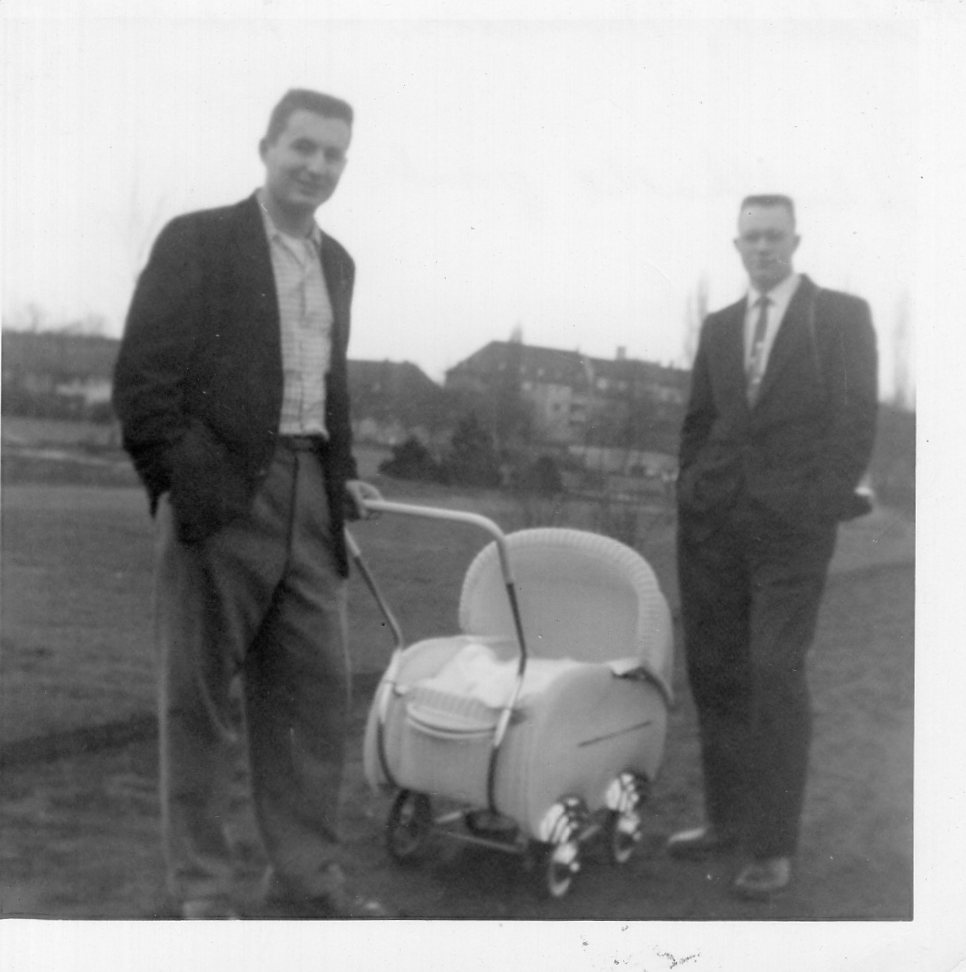
 Below are Mr. & Mrs. Benno Hahn and Mr. & Mrs. Howard Keillor, probably about the late 1920s.


Sunday, July 22, 2012

Nurses in Combat Boots


On a recent visit with us, my mom brought a ridiculously heavy green suitcase full of what she told me was family history books. Not having time to cope with it, I set it in the “junk room” and spent a couple of months ignoring it. I know that there’s a reason I opened it up, but now I don’t remember why. But it was like opening up Pandora’s Box, because once it was opened, there was no going back! There were several family history books, but there were also many invaluable family mementos such as Uncle Phil’s medals, their WWII ration books and letters between my Great Uncle Phil and his grandmother during WWI (that's a whole 'nother blog post!). There were also dozens of clipped obituaries from many different newspapers, and someone had taken the time to make sure there was a date written on most of them. One such obituary was for Mary Aloise Canning. Mary’s mother, Ernestine Rose Vautrinot Canning was a younger sister of my great-grandmother, Grace Eugenie Vautrinot Wenz.
Here is the text of the obituary, from the Boston Globe, dated 4 Sep 1987:
          “DEDHAM – A funeral Mass was to be said Sept. 8 at St. Mary’s Church, Dedham, for Mary A. Canning, who died Sept. 4 at the Goddard Home, Jamaica Plain. She was 86.
          Born in Dedham, and a lifelong resident. She was a graduate of Massachusetts General Hospital Nursing School, Class of 1921. Miss Canning was employed at the hospital until 1941, when she joined the U.S. Army Nurse Corps. During World War II, she served in Casablanca, North, Africa, and assisted wounded troops through the Italian campaign, serving troops at Monte Cassino with distinction.
          Upon the conclusion of the war in Europe, she served in the Far East, arriving in Tokyo shortly after the Armistice was signed. She retained the rank of major when she retired. After she returned to Dedham, she worked as a public health nurse for the Commonwealth of Massachusetts, retiring in 1967. Miss Canning was a member of the Dedham American Legion Post.
          She was the daughter of the late Thomas and Ernestine (Votreneau [sic]) and the aunt of Richard Canning of Wilmington, Del., Edward X. Canning of Fairfield Conn., Harry Canning of Hudson, Ohio, Thomas Canning of California and Rita Meuer of Hagerstown, Md.
          Arrangements were handled by the George F. Doherty & Sons Wilson-Cannon Funeral Hom, 456 High St., Dedham. Burial will take place at Brookdale Cemetery, Dedham.
Having an interest in military history, I was entranced to think someone with whom I was closely related played a critical part in such important campaigns in WWII. The more I read, the more I was impressed with her contributions and distressed to know that the involvement of these women has been so overlooked by history. I read an excellent work by Evelyn Monahan and Rosemarie Neidel-Greenlee entitled “And if I Perish,” which details their amazing service. When the troops landed in Africa, those nurses, including Mary Canning, were landing right next to them. Between Africa and Italy, they had two hospital ships bombed out from under them. In Italy, the nurses were delayed in landing for three days, but remained trapped with the troops on Anzio Beach, otherwise known as “Hell’s Half-Acre,” for the entire time of the German bombardment. This was the first time in U.S. Military history where nurses in uniform travelled just behind the combat troops, and in many ways, they were making it up as they went along.

Like Uncle Ned, she passed away before I was ever aware of her history. But I have been in correspondence with one of her nephews who graciously shared her photo with me. He told me that “she was a very outgoing person and liked to party. She spent much time keeping in touch with relatives. I don’t think she felt that all her activities were any hardship. She rather enjoyed all her adventures.”

 L-R Jack McLaughlin, Millie Irving Wenz, with her husband Fred Wenz behind her, Emily Wenz Morse, Mary Canning, Marie Wenz McLaughlin and Dot Irving Wenz (my grandmother). The occasion was probably the anniversary of the McLaughlins, taken at their home in Hanson, MA in 1975.

And I’ve just learned that I had actually met her in 1975! Oh, that I had known! Hopefully more research will reveal more details of her life and I’ll be able to update this post with more detail soon. 

Tuesday, July 17, 2012

Aunt Tille and the Wenz Family


Every family has at least one brickwall, and as many methods of climbing over them. One of my strategies was to write a family history of one of our lines that ended at that ancestor’s immigration into the United States.
What an undertaking it became! But it forced me to re-examine thirty years of evidence and helped me to find some clues I’d overlooked.
Twenty-six pages later, my data had congealed into a reasonably decent narrative that I felt I could share with family members, known and unknown. Now, how to distribute it? Since I’m currently out of work, it had to be very budget-friendly. Well, I had plenty of stamps and envelopes and access to online people searches – so I went looking for distant cousins. I started with just one line – the Maitlands. I had been in contact with one of the cousins years ago, and was dismayed to learn that he had since passed away. But his obituary listed the names and towns of his siblings and children, so I wrote six letters. Well, one of them hit paydirt! I heard from the granddaughter of Aunt Tillie, my great-grandfather’s older sister. Tillie had lived with them for a time after her husband passed away.

The cousin shared a few stories with me that contained some important clues, and I’ll share a few of them here:
“During the second WW, my Mom worked several hours a day in a cemetery greenhouse.  My Mom had the greenest thumb you could find.  So....Grandma Maitland took care of us kids, or vice versa many times.  She was funny, because she wanted the neighbors to think that she was earning her keep - she would stand in one place on the sidewalk with a broom in her hand and sweep periodically. That was long before senior residences.  Altho, when she lived with Uncle Bill in Delaware, she told me that to keep busy there, she would take the bus to the Nursing Home to visit the "girls".  She was 10 years older that most of them were, but they were her friends.  I remember visiting at her home when Grandpa was still living.  They had an old pump organ, which my kid brother and I loved.  We could not reach the peddles and the keys at the same time, so we took turns.  He would play while I pumped the peddle and then we would change places.  Didn't bother Grandma doing it that way. Grandma Maitland (Wenz) lived with us about 6 months of the year after Grandpa died.  She had two sons, William and Robert Laurie Maitland, Jr. (my dad).  They took turns caring for her until she died.  She told me, since I was the youngest and would listen, stories about growing up in her family.  She said that they never spoke anything but German until they went to school.  She taught me one little verse in German that they always insisted she learn and it still is with me a lot, and she told me about her brother and his understanding of American idioms.  He was chopping wood and seemed to struggle with it.  They told him he needed more "elbow grease".  The next thing they saw was her brother in the yard greasing his elbows.  I always assumed it was Uncle Ed, who may be your grandfather figure.  I remember him well, because he came once in a while to visit with Matilda.  He was a beautiful person - very large- and very gracious, especially with us a little kids.  He had the biggest hands I ever remember, but he was a farmer in the Boston area and I assumed that was his largest."
What a great peek inside my family history – the real people, not just the names and dates on a page! So, reach out to distant cousins – you’ll never know what you’ll find!
And the book? Here's the link: https://docs.google.com/open?id=0B47bUrlyCkJhRndzeGx3NlQ4eFk

Monday, April 16, 2012

How My Gramie & Grampa Met


I wish I had learned earlier that the stories of peoples’ lives were so much more important than filling in sheer facts of dates and places on a form. But I’m thankful that I did ask my Gramie about how she met my Grampa. I had been hesitant to ask, because he had passed away only a few years earlier and I had a strong sense that she still missed him very much, so I was hesitant to ask her for fear of bringing up painful feelings.
She seemed to enjoy talking about him and told me that she met him when she was at work at the shank shop. 

Her job was to tape the metal shanks that became the arch supports for shoes. At that time (the 1930s) that area of Massachusetts was still a huge shoe-working center – think “Bostonian Shoe.” It seemed ironic to me that they had met at the shank shop, since it was right up the street from their home and I had memories of hearing them talk about it all my life.


He was a truck driver, and delivered supplies to the factory. 


She said he would always wink at her when he came in, until finally, the red-headed son of Irish immigrants asked the beautiful daughter of Italian immigrants for a date. 


They were married at the Holy Ghost Catholic Church in Whitman on 27 November 1932 and remained together until his death in January of 1971. 


They had three sons, my dad, Edmund (front left), and my uncles Kevin (front right) and Shawn (the baby). 

This is how I remember them best; the photo was taken at Uncle Kevin & Aunt Mary Lou's wedding. The gent on the left is my dad.


Friday, August 5, 2011

How I Contracted the Disease

When I was a kid in the 1970s, my mother’s family had somewhat regular family reunions in the summer. There were essentially two branches of the Wenz family, located in New York/New Jersey and Boston. Most of the reunions I remember were in Boston, except for one big one in 1976 in New Jersey. Each year, I would have an opportunity to hang out with cousins who were ostensibly related to me and then not see them again until the next reunion. My mother’s mother, Dorothy Mae (Irving) Wenz, lived in Miami, and would come up for a visit at the time of the reunions. As we were preparing for the 1976 reunion, I was sitting at the kitchen table with Grandma Dot and I asked her how I was related to the cousins I only saw once each year.

It was a bit of a tangled situation, the result of the marriage of two sisters, Dot and Millie Irving and their marriage to two brothers, Ted and Fred Wenz. I finally had to get out a piece of paper and draw a little chart to keep things straight. As she waited for me to draw the lines, she would tell me stories of her childhood.

Her father was an immigrant from Canada, where he used to run the ferry from St. John, New Brunswick to Boston. One trip, it seems, he just got off the ferry and never got back on it. Eventually he got a job with the Houghton Publishing Company in Boston (millions of schoolchildren then and now will recognize the Houghton Mifflin name!). He used to bring home the seconds to his children, starting them, and subsequent generations, on a lifetime of a love of literature.

Grandma Dot said that her legs were bowed as a child, and that her father had dug a shallow trench in the backyard, sit her in it and pack her legs with dirt each day. I don’t remember how long this process took, but eventually, my grandmother had nice, straight legs.

To this day, thirty-five years later, I can still remember the magic of that moment – I loved the stories about the people and the history and wanted to know more! I embarked on a mission to accumulate dozens of vital records certificates from the Massachusetts Department of Public Health, and each one provided both missing pieces of the puzzle and more holes in the puzzle! From the scrap of paper (which I still have) came a half dozen poster boards delineating the Wenz-Irving family for the reunion. Wonder what became of them?

Then one day two LDS missionaries came to the door while I was working on the posters. I could say coincidentally, but I’ve come to know that there are no coincidences in the work of family history. There just happened to be a woman in town, part of the only LDS family in town, who know a lot about family history.

Learning about the genealogical resources of the LDS Church opened up a whole new world to me. In September of 1976, I moved to Miami and went to my first local Family History Center, in the Miami 1st Ward building, with Sister Edna Slay as director.

Since then I’ve spent countless hours in Family History Centers, National Archives Branches and online and had some marvelous “adventures of the Spirit.” Oh, and I'm a Mormon now!

Tuesday, February 1, 2011

La Belle France

Last semester in my French class I was given the assignment to create a digital storytelling project on some aspect of the Francophone world. I decided to do mine on the story of my French ancestors and their journey to the United States.

My 3rd great-grandparents, Joseph and Marie (Seltz) Drach came from the town of Benfeld, in the Bas Rhin region of France. Around 1843 they took their two daughters - Ernestine and Marie Aloise, and left Benfeld for Le Havre. Joseph's brother Antoine, his wife Marie Anne (Gastiger) and their five children. They apparently stayed there for a time, as Emil and Josephine were born there, and Ernestine died.

They sailed from Le Havre on the ship William Goddard and arrived in Boston on August 26, 1847 and traveled to Lowell, Massachusetts. There is a large French community there, although it is primarily Quebeçois.Joseph Drach became a naturalized citizen in Lowell in 1894. His son-in-law, Hugh Gillon, was one of his witnesses.

Emil enlisted in Company K, 31st Massachusetts Infantry in February of 1862, and by December he was dead, killed by a sniper's bullet. But that's another blog.


The parents of Marie Aloise's husband, Theodore Antoine Vautrinot, were Jean Antoine and Marie Rosalie (Munier) Vautrinot. They came from Liepvre in the Haut Rhin region. They sailed on the ship "Mary & Adele" (637 tons) from Le Havre and landed at the Port of New York in January of 1855. From New York they traveled to Boston. Marie Rosalie gave birth to two more girls, but by 1862, she and the two girls had died. Theodore was their oldest child, and by this time he had already married Marie Aloise and started a family of his own. Jean Antoine took Marie Louise and Jean Jr. and moved to Egg Harbor City, New Jersey.

This is one of the great family mysteries. First, why didn't they stay in NYC when they landed in 1855? Then, after Marie Rosalie died, why pull up stakes and go to NJ? Egg Harbor City was a planned community as a safe haven for German immigrants, mostly Moravians. The Vautrinots have traditionally been French Roman Catholic.

The Vautrinot and Munier families have made their own individual marks in American history. Donald Vautrinot was a member of the Army Air Corps stationed in the Philippines at the start of WWII, and survived the infamous Bataan Death March only to die in a prison camp shortly before its liberation.Mary Canning, daughter of Ernestine Vautrinot Canning was an Army Nurse in the African and Italian campaigns and finished the war in Tokyo. Many other Vautrinots fought to defend their country in WWII, Korea and Vietnam.
Madeline Vautrinot was a well-known artist in New Jersey, and was commissioned to paint several WPA murals, including one in the Atlantic City Post Office. Her father was a banker who established a scholarship at the local high school which still exists today.
Ferdinand Munier was a bit player in 1930s Hollywood, acting in movies with the likes of Fred Astair and Lucille Ball. He played Santa Claus in Laurel & Hardy's "Babes in Toyland," and a senator with Will Rogers in "Ambassador Bill" that you can watch on youtube here: http://www.youtube.com/watch?v=_F2MYMiHpdU


In 2002, I was privileged to be able to travel to France to see the beautiful towns of Benfeld and Liepvre and drive through this beautiful region.

If I ever get the audio straightened out on my project, I might just post it on my blog!

Sunday, January 30, 2011

From the Birth of Naval Aviation to the Jet Age in One Lifetime of Service


When Edward Aloysius “Ned” Wenz was born in Massachusetts in 1893, controlled flight was still only a dream. But by the time he graduated from Boston College in 1914, flight was taking its first ascents out of infancy. It was only five years earlier that British politician David Lloyd George had proclaimed “flying machines are no longer toys and dreams, they are an established fact.

In May of 1917, Ned enrolled in the U.S. Navy as a Seaman 2nd class. He then attended and subsequently graduated from MIT Ground School Training. He was commissioned an Ensign and earned his Aviator’s Wings in December of that year in Pensacola, Florida. His Naval Aviation Number was 224.

While in Pensacola, Ensign Wenz earned a commendation for bravery for his actions as part of Group 8’s actions during a hurricane. The War Bureau citation states it was “pleased to note that your action in this case has demonstrated that you are willing to take advantage not only of the responsibilities of the naval service, but also of its opportunities for service outside the routine of duty. Your action in this case is heartily recommended.”

The Navy sent him overseas to Budleigh Sallerton, England the following February, and in May, experienced a crash landing that sent him to the hospital for a month. Ned received his promotion to lieutenant in October of 1918 and was loaned to Britain’s Royal Flying Forces and based in Whiddy Island, Ireland.

Sometime between the end of the war in November of 1918 and 29 Jan 1920, Ned was enumerating the 1920 Federal Census in the Panama Canal Zone, listing the names and hometowns of the officers and sailors of the U.S. Naval Air Station Coco Solo in his own neat penmanship.On his way to Coco Solo, he met a beautiful young lady from Missouri who was traveling to Panama after graduation to visit with her stepbrother for two years.

While there, he took her up in an airplane and flew her over the canal. They were married in Missouri in 1922. After his marriage, Ned was sent to Naval Reserve Aviation Air Wing 92 at NAS St. Louis and Lambert Field in St. Louis as part of VF-75A.

Ned moved his wife and daughter to Michigan around 1929 when he received orders to command Naval Reserve Air Base Grosse Ille. The columns in the 1930 Federal Census include the columns“Occupation” and “Industry,” and they list him as “Commanding Officer, U. States Naval Base. The dedication ceremonies for Detroit’s Ambassador Bridge in 1929 featured a flyover by Lt. E.A. Wenz, USNR and ENS C.R. Olson, USNR, each flying an NY-2 seaplane from the base at Grosse Ille.

Between his time at Grosse Ille and the outbreak of WWII, Ned worked a series of civilian jobs while retaining his reserve status. At the time of the attack on Pearl Harbor, he was working for the Bureau of Alcohol, Tobacco and Firearms. Even though he was now 48, he was recalled to active duty. He was sent first sent to Corpus Christi, Texas, and then to the Naval War College in Newport, Rhode Island. He graduated from the NWC in June of 1943, and was sent to Norfolk, VA. His service record lists his Navy Active Service for 16 Feb 1942 – 22 Jan 1946 as COMAIRLANT, Commander Air Force, Atlantic Fleet. At some point, he was sent to San Diego, and was in Saipan when peace was declared, although he did not fly planes due to his age.


After the war, he returned to St. Louis and retained his Reserve status until he retired from the Revenue Service at age 60 in 1953. He died in 1985 and is interred at Jefferson Barracks National Cemetery in St. Louis.


I never had the good fortune of meeting Uncle Ned; it was many years after his death that I learned about his amazing history in Naval Aviation. Would that I could have sat at his feet and heard his story! This is a work in progress and I hope to be able to add more information as I gather it. Good thing Chief Keillor is now stationed in Pensacola!