Showing posts with label Leitrim. Show all posts

Sunday, February 16, 2020

To Sit Beside a Turf Fire...

In spite of my varied genealogical background, I was raised Irish. Didn't matter that my father's mother's parents came off the boat from Italy, in my father's mind, we were Irish. St. Patrick's Day was celebrated year-round, and on March 17th, watch out!

L-R Shawn, Mike, Ed, Pete and Edd; yours truly front & center
This would have been before 1971, the year Edd passed away. 
Edd's parents were Irish immigrants. 

Ed, St. Pat's 1969

Early 1970s?

So it should come as no surprise that I know a lot of Irish songs, especially Irish American songs. One in particular was especially poignant: "Galway Bay" in which an Irish emigrant to America speaks of returning to Ireland to "sit beside a turf fire in a cabin."


When Ed was alive, he would always tell Howard and myself what he was going to leave us in his will, and I would always tell him that I would go to Ireland in his memory and he seemed to like that idea. 

As we planned our trip to England this past Christmas, I thought about the logistics of getting to Ireland, but it seemed a little overwhelming. But as in all great genealogical endeavors, it worked out perfectly in the end!

We landed in Dublin airport and were welcomed by that "soft Irish weather." All signs in Ireland are in Irish (Gaelic) and English. 

My first glimpse of Ireland

We rented a little VW Golf, which had a sticker taped to the steering wheel that said "Stay Left!"

(note the cow escaping backwards from his pasture)

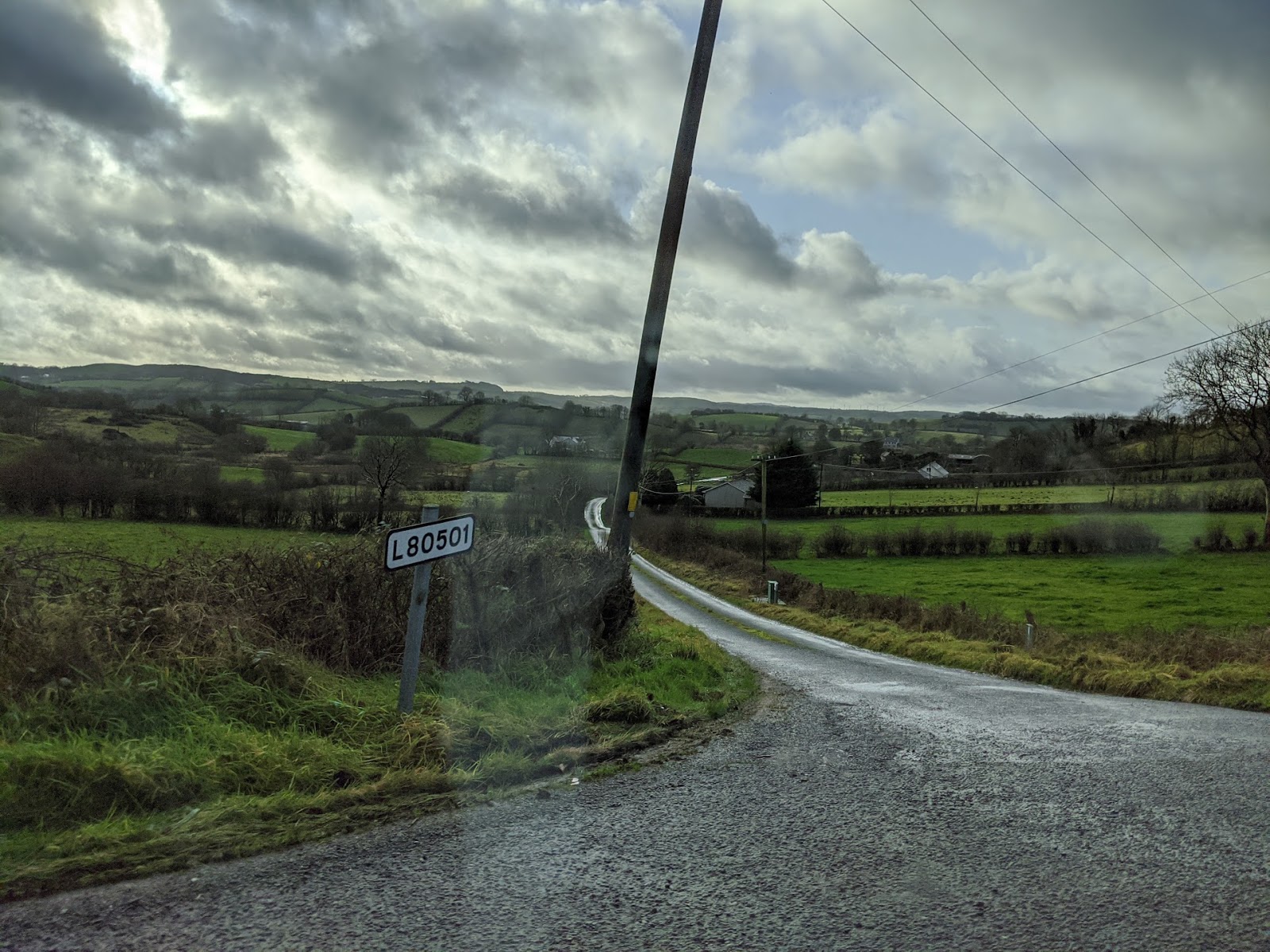
You've likely heard of Ireland referred to as "The Emerald Isle." No photographs can do it justice; even on a rainy January day, it's green-ness was amazing:

We drove first to Clones, Co. Monaghan, where my great-grandmother, Kate Beggan Smith was born. We had a lovely walk around the town, enjoying the sunshine, although it was chilly.


This photo was taken from the Sacred Heart Church, the Catholic Church in Clones. The current building was built after my great-grandmother left Clones for America, but it was built on the same site as the previous building, and I suppose all her relatives who remained in Ireland would have attended this building. 

Clones is an ancient town, featuring a 9th century round tower and the ruins of a 12th century abbey:


The next morning we drove to Ballinamore, Co. Leitrim, the ancestral hometown of the Smiths. If you know anything about Ireland's history, you know that it is one island, two nations; the Republic of Ireland and Northern Ireland, the latter being part of the United Kingdom. Both Clones and Ballinamore are very close to the border between the two countries, but are part of the Republic. Yet in that 50-minute drive, we crossed the border between the two several times! 


Previous to our trip, I had contacted the Genealogy Centre of Leitrim (pronounced LEE-trim) and got some great help from Patricia, so we made that our first stop so I could thank her in person for the help. We picked up a few other bits of info, including the fact that John's father Patrick likely went to England for work and died there. So, a new avenue for research!


After we walked around the town for a bit, I returned to the center to ask about which church might have been in Ballinamore when my ancestors' family lived there. Patricia explained that the church that was there then was sold to become a furniture store, which has since gone out of business. She pointed out it's location just up the hill from the new, modern Catholic church. Just as I was turning to leave, an older gentleman popped out from behind a bookshelf to remind her that at the time of the sale of the old church, the altar was removed and placed in the new church.
The defunct hardware store.

The altar from the old church in the new church building.


From Ballinamore we drove back to Clones. Refer back to my post of 22 July 2010 to learn how I found my living Irish cousins. I contacted John again and he did a fantastic job of lining up a visit with Kathleen and Benny, whose grandmother was a sister to my great-grandmother. 

We were supposed to have also met with Rosaleen, whose father Peter was my great-grandmother's brother. She is in her 90s, but had caught a cold and couldn't meet with us. Otherwise, we could have taken a 4-generation photograph! Benny brought his daughter and granddaughter with him to Kathleen's house. 

As we walked into Kathleen's, she had a turf fire warmly glowing. As the words to "Galway Bay" went through my head, it seemed that a conduit opened up and I felt connected to a thousand years of Irish history. We had a delightful visit and found that although we were from different cultures we had so much in common!

"To sit beside a turf fire..."

After Kathleen served us tea, Benny drove us out to the cemetery, where I saw for myself a headstone that I had seen in photographs for many years: That of my 2nd great-grandparents, Bernard and Catherine "Kitty" (Learo) Beggan. 


On our way to the airport the next morning, we met with John again, this time at the Library of Trinity College in Dublin. Heaven! We enjoyed an all-to-brief visit with John as he walked us through the National Gallery of Ireland. I sincerely hope we can return soon and spend more time with family and in a remarkable country.


Thursday, July 15, 2010

John Joseph Smith

My father's father's father was born in
County Leitrim, Ireland on 26 May, 1864. His parents were Patrick and Catherine (Gookin or Guckin) Smith. I learned his parents' names from his Social Security application from 1943, but more about that later. He already had two sisters and one more was born in 1867. My dad's cousin Neil remembers hearing that Patrick was killed in a mining accident and that's why Catherine took the children and came to Boston. It appears from the passenger lists that they went first to Liverpool.

The document above was handed to my dad from one of the "aunts" (how we referred to John's daughters) at the funeral of one of the other aunts. She asked my dad if I was still working on the family tree and asked him if he thought this scrap of paper would be helpful to me.


As I'm writing this, the process is gelling ideas in my head of new avenues for research! For example, I should check to see what years they may have been in Liverpool against the British census records to see if I can find them there. I should also search for Patrick's death between the year Bridget (the youngest sister) was born and the year he arrived in Boston. So, not a bad idea to be a family history blogger!

Below is the Batavia, the ship on which John sailed alone as a 16-year old boy in 1881 from Liverpool to Boston.

When John arrived in Boston, he lived in Avon, which is just outside Brockton. At the time, the Brockton area of Massachusetts was a huge shoemaking center (think Bostonian shoe, which has since been bought by a British firm and moved out of state). I don't know if John learned his trade in Ireland, Liverpool or not until he came to the U.S.
About the same time I was searching for information about John Smith, I had applied for my own Social Security account. Because I was an Army brat born in Germany in the Stadtkrankenhaus, my birth certificate says "Gebertsekunde" across the top. What a time I had trying to get an account with that birth certificate! That set me to thinking - what about John? I knew he had an account from his death certificate. What process did he have to go through to get one? All of the angels of family history must have been setting things in motion, because I was living in the same district where John was living, plus this was before the time the SSA realized that making copies of applications for genealogists was a financial gold mine. I was also amazing that John actually applied for an account!

His application was dated 1943, when he was 79 years old. Not long after I located the application, I was at a Smith family gathering and wondering aloud for what reason John would have to apply for an account. One of my cousins, I think it was Neil again, said that it was the U.S. Army who brought him out of retirement to make boots for officers, because he was one of the few remaining shoe workers who knew how to make good, durable boots by hand.

In 1888, he became a naturalized American citizen, and from the information he gave during that process, I was able to find his passenger list.

He married Catherine Beggins in 1893
and they had 10 children (see my 14
Jul blog for the children). The house in the photo on the right is the home where they lived for most of their lives as a family.

When I was going through the standard "getting over the brick wall" checklist, I asked his youngest daughter if he left a will. Her response startled me - she laughed outloud! No, she told me, he drank every nickel he ever learned. She told me she was amazed that her mother was ever able to feed them all. Most of the children got jobs at very young ages.

He died in 1949 of a pulmonary embolism and is interred in St. James Cemetery in Whitman, Massachusetts.


Sunday, July 11, 2010

Brick by brick...

Every family historian has at least one brick wall. Some walls are higher and more well-constructed than others. In my family tree, I have two ancestors whose ancestral hometowns I have been searching for since I started climbing the tree in 1976. One of them was my Irish great-grandfather who sailed into Boston in 1881. His name: John Smith. Yup, that's right, the ubiquitous John Smith. Now, he had been blessed with a middle name, Joseph, but that only narrows it down a tad from all the others, and only if the middle name had been stated or recorded on the document. I usually find him listed as John J. Smith.

I was very fortunate to have started this when most of John's ten children were still alive and lucid. They were very willing to talk about the family and gave me as much information as they could remember. From the beginning, they had told me that he had been born in County Leitrim. As I learned how to use an LDS Family History Center, I searched through the indexes of Leitrim biriths, but without any more identifying information about him, it was impossible to identify him from all the others. But over the years, I've collected plenty of detail such as his full birth date and his mother's maiden name, which is the opposite of Smith: She was born Catherine Guckin or Gookin; I've seen it documented both ways. This name becomes important to this story.

Recently I was online comparing my Personal Ancestral File (PAF) records against the familysearch.org pilot site. This is where all the work that's being done by the anonymous army of indexers throughout the world ends up. Until this point it had been a rather hum-drum pursuit, only finding little tidbits of information here and there, but nothing of real import. Then, as I searched for John's sister Bridget, there it was: She was christened in the town of Ballinamore, County Leitrim in 1867. If not for the fact that her mother's maiden name was listed, I might have passed it by as just another Smith, but there it was. It was a great Eureka! moment.

Of course, this has opened up new avenues of research, as I can now post this information on Rootsweb and other genealogy sites. I can look in the Family History Library card catalog to see what additional church records might exist for the year John was born. I did check the record group Bridget was in for the other siblings in the family, but she was the only one. That, however, has been typical of any of my ancestors who have been scooped up by extraction or indexing - only one gets caught in the net of the record group, but one is all it takes.

The photograph is of John holding my dad, so this picture must have been taken around 1936. In my next blog, I hope to put together a mini-bio of John Joseph Smith.