Showing posts with label Smith. Show all posts

Sunday, February 16, 2020

To Sit Beside a Turf Fire...

In spite of my varied genealogical background, I was raised Irish. Didn't matter that my father's mother's parents came off the boat from Italy, in my father's mind, we were Irish. St. Patrick's Day was celebrated year-round, and on March 17th, watch out!

L-R Shawn, Mike, Ed, Pete and Edd; yours truly front & center
This would have been before 1971, the year Edd passed away. 
Edd's parents were Irish immigrants. 

Ed, St. Pat's 1969

Early 1970s?

So it should come as no surprise that I know a lot of Irish songs, especially Irish American songs. One in particular was especially poignant: "Galway Bay" in which an Irish emigrant to America speaks of returning to Ireland to "sit beside a turf fire in a cabin."


When Ed was alive, he would always tell Howard and myself what he was going to leave us in his will, and I would always tell him that I would go to Ireland in his memory and he seemed to like that idea. 

As we planned our trip to England this past Christmas, I thought about the logistics of getting to Ireland, but it seemed a little overwhelming. But as in all great genealogical endeavors, it worked out perfectly in the end!

We landed in Dublin airport and were welcomed by that "soft Irish weather." All signs in Ireland are in Irish (Gaelic) and English. 

My first glimpse of Ireland

We rented a little VW Golf, which had a sticker taped to the steering wheel that said "Stay Left!"

(note the cow escaping backwards from his pasture)

You've likely heard of Ireland referred to as "The Emerald Isle." No photographs can do it justice; even on a rainy January day, it's green-ness was amazing:
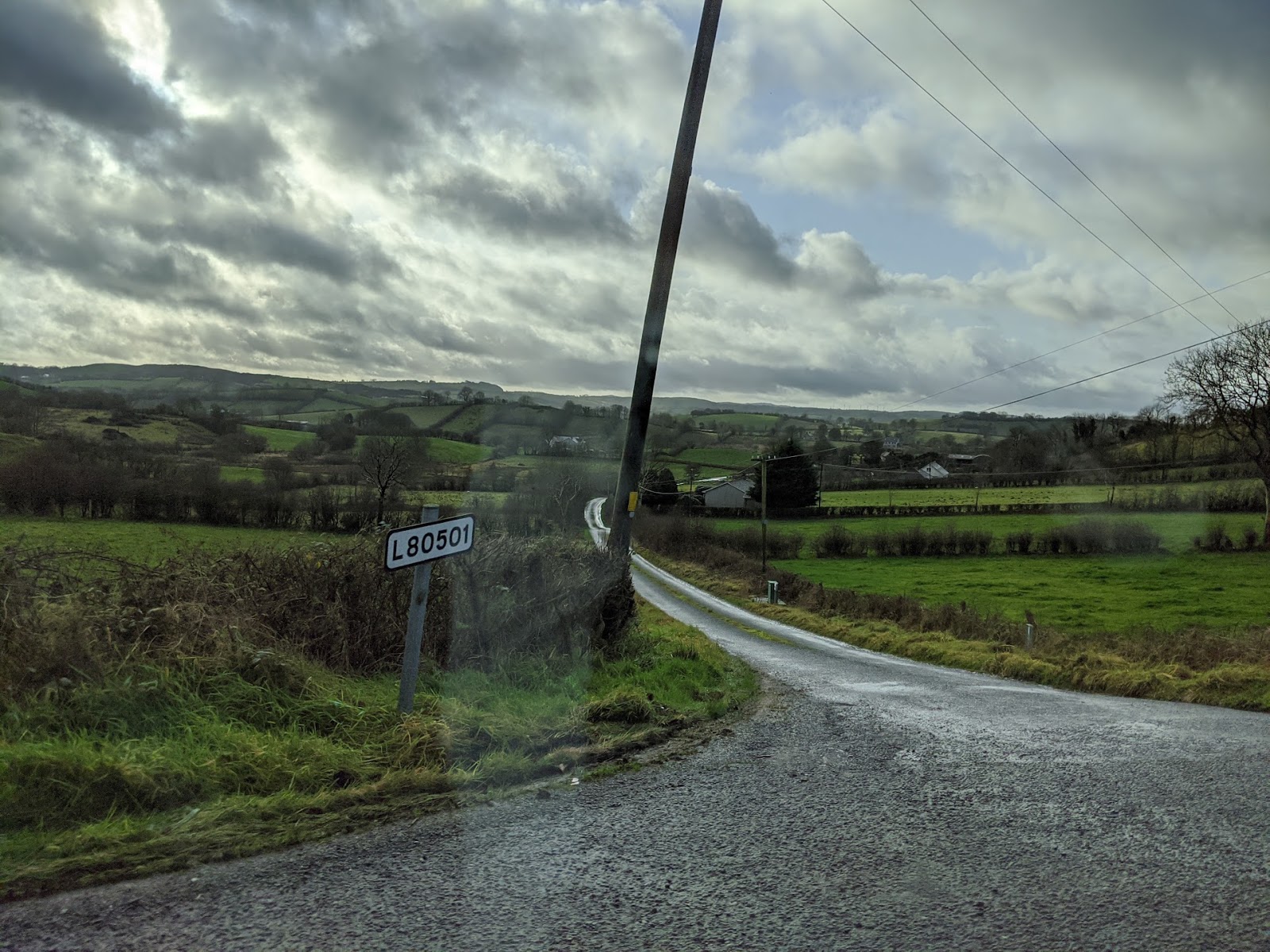

We drove first to Clones, Co. Monaghan, where my great-grandmother, Kate Beggan Smith was born. We had a lovely walk around the town, enjoying the sunshine, although it was chilly.


This photo was taken from the Sacred Heart Church, the Catholic Church in Clones. The current building was built after my great-grandmother left Clones for America, but it was built on the same site as the previous building, and I suppose all her relatives who remained in Ireland would have attended this building. 

Clones is an ancient town, featuring a 9th century round tower and the ruins of a 12th century abbey:


The next morning we drove to Ballinamore, Co. Leitrim, the ancestral hometown of the Smiths. If you know anything about Ireland's history, you know that it is one island, two nations; the Republic of Ireland and Northern Ireland, the latter being part of the United Kingdom. Both Clones and Ballinamore are very close to the border between the two countries, but are part of the Republic. Yet in that 50-minute drive, we crossed the border between the two several times! 


Previous to our trip, I had contacted the Genealogy Centre of Leitrim (pronounced LEE-trim) and got some great help from Patricia, so we made that our first stop so I could thank her in person for the help. We picked up a few other bits of info, including the fact that John's father Patrick likely went to England for work and died there. So, a new avenue for research!


After we walked around the town for a bit, I returned to the center to ask about which church might have been in Ballinamore when my ancestors' family lived there. Patricia explained that the church that was there then was sold to become a furniture store, which has since gone out of business. She pointed out it's location just up the hill from the new, modern Catholic church. Just as I was turning to leave, an older gentleman popped out from behind a bookshelf to remind her that at the time of the sale of the old church, the altar was removed and placed in the new church.
The defunct hardware store.

The altar from the old church in the new church building.


From Ballinamore we drove back to Clones. Refer back to my post of 22 July 2010 to learn how I found my living Irish cousins. I contacted John again and he did a fantastic job of lining up a visit with Kathleen and Benny, whose grandmother was a sister to my great-grandmother. 

We were supposed to have also met with Rosaleen, whose father Peter was my great-grandmother's brother. She is in her 90s, but had caught a cold and couldn't meet with us. Otherwise, we could have taken a 4-generation photograph! Benny brought his daughter and granddaughter with him to Kathleen's house. 

As we walked into Kathleen's, she had a turf fire warmly glowing. As the words to "Galway Bay" went through my head, it seemed that a conduit opened up and I felt connected to a thousand years of Irish history. We had a delightful visit and found that although we were from different cultures we had so much in common!

"To sit beside a turf fire..."

After Kathleen served us tea, Benny drove us out to the cemetery, where I saw for myself a headstone that I had seen in photographs for many years: That of my 2nd great-grandparents, Bernard and Catherine "Kitty" (Learo) Beggan. 


On our way to the airport the next morning, we met with John again, this time at the Library of Trinity College in Dublin. Heaven! We enjoyed an all-to-brief visit with John as he walked us through the National Gallery of Ireland. I sincerely hope we can return soon and spend more time with family and in a remarkable country.


Sunday, February 2, 2014

Dig a Little Deeper

I never met Louis (pronounced in the French “Loo-ie”) Derragon (der-A-gun). But over my lifetime, I heard so many stories about him that I felt that I had known him. He died in his mid-forties, a few years before I was born, and according to my dad, he was asthmatic, so apparently that was a contributing cause of death.
His photos all show a handsome, open smiling face, and the whole family seemed to hold him in the highest regard.

 One photograph shows him in the traditional Navy “crackerjack” uniform. My dad remembered that he worked at the Fargo Building in Boston as a recruiter, since he was restricted by his asthma. Many years later in an ancestry.com search, I came across the application for a military headstone for him. I was surprised to see it listed his service aboard the USS Ira Jeffrey as a Ship’s Cook First Class.

It was very interesting to learn about the history of the USS Ira Jeffrey. Based on the time period of Louis’ enlistment, 7 November, 1942 – 25 Sep 1945, and the time line of the Ira Jeffrey, 13 February 1943 until it was sunk in a target exercise off the coast of Charleston, SC in 1962, it looks like Louis may have been a “plank owner,” or part of the original ship’s crew. It also suggests that Louis may indeed have spent some time as a recruiter in Boston before his time aboard the Ira Jeffrey.

A history of the Charlestown Navy Yard published by the National Park Service states: “The Fargo Building on Summer Street in South Boston which served as headquarters for the First Naval District. The building today is owned by the Army and known as the Barnes Building.” It was a recruiting and processing station for the Navy during WWII.

The Ira Jeffrey was built at the Bethlehem-Hingham Shipyard in Hingham, Massachusetts in 1943 and was sponsored at its launching by the mother of the young Ensign for whom the ship was named. The shakedown cruise took her crew from Maine to Bermuda, and then an assignment to Quonset, RI. From there, she escorted eight troop convoys to Europe. From The Dictionary of American Fighting Ships, we learn that: ‘On the [last] return crossing, 20 December 1944, the escort's convoy was attacked by a German submarine.  After sinking an LST and damaging destroyer escort FOGG (DE-57), the submarine was driven off.  IRA JEFFERY assisted the damaged ship and eventually escorted her through rough seas to the Azores.”
Following her cruises across the Atlantic, the Ira Jeffrey was converted to a high-speed transport at New York Shipyard, and following a shakedown cruise in the Chesapeake Bay, she “then sailed 25 May with aircraft carrier ANTIETAM (CV-36) for the Panama Canal and Pearl Harbor, where she arrived 18 June 1945.”
In San Diego, she began training with underwater demolition teams which entered Pacific beaches in advance of the “American occupation landings,” and after island-hopping her way across the Pacific, returned to San Diego. The Ira Jeffrey was decommissioned  in Jacksonville, Florida in 1946.
Although he is listed as a Ship’s Cook, I know that he must have received other training, at least as a fireman – all Navy ships train their crew as fire/damage control. I was able to learn a good deal more, thanks to Tim Rizzuto and the wonderful museum of the USS Slater in Albany, NY. Visit their website here: http://www.ussslater.org/ Tim took the time to answer a few questions via email and fill in some of the blanks, such as during WWII, Louis probably received gunnery training as well.


I have not yet acquired the marriage record of Louis Philizia Derragon to my Aunt, Agnes Louis Smith, but they were married in 1945, and remained wed until his death in 1955. It is a great regret of mine that I did not take the time and overcome some timidity to ask Aunt Agnes more about a man with such a history as Louis Derragon. 

Monday, April 16, 2012

How My Gramie & Grampa Met


I wish I had learned earlier that the stories of peoples’ lives were so much more important than filling in sheer facts of dates and places on a form. But I’m thankful that I did ask my Gramie about how she met my Grampa. I had been hesitant to ask, because he had passed away only a few years earlier and I had a strong sense that she still missed him very much, so I was hesitant to ask her for fear of bringing up painful feelings.
She seemed to enjoy talking about him and told me that she met him when she was at work at the shank shop. 

Her job was to tape the metal shanks that became the arch supports for shoes. At that time (the 1930s) that area of Massachusetts was still a huge shoe-working center – think “Bostonian Shoe.” It seemed ironic to me that they had met at the shank shop, since it was right up the street from their home and I had memories of hearing them talk about it all my life.


He was a truck driver, and delivered supplies to the factory. 


She said he would always wink at her when he came in, until finally, the red-headed son of Irish immigrants asked the beautiful daughter of Italian immigrants for a date. 


They were married at the Holy Ghost Catholic Church in Whitman on 27 November 1932 and remained together until his death in January of 1971. 


They had three sons, my dad, Edmund (front left), and my uncles Kevin (front right) and Shawn (the baby). 

This is how I remember them best; the photo was taken at Uncle Kevin & Aunt Mary Lou's wedding. The gent on the left is my dad.


Wednesday, July 14, 2010

The Propagation of the Smiths


Well, while I'm trying to finish John Smith's bio, I wanted to share this photograph of his family. This is the only photo that I'm aware of that contains all but one of his ten children. The occasion of the gathering was their aunt Rose Beggins Ordway's 80th birthday. In order, with their spouses are:
1. Kate, never married.
2. George, & his wife Minnie (Kiley). George was a veteran of WWI.
3. Everett "Boxer," never married.
4. Lillian, & her husband Lawrence "Larry" Sears.
5. Edmund (my grandfather), & his wife Mary Guidetti is in the far left chair.
6. Bernard is the one missing child. He married Yvonne Donoghue.
7. Mary and her husband, Leroy Owens.
8. Irene, never married.
9. Helen & her husband, Amerigo "Dick" Guidetti. His sister is also my grandmother - confused yet?
10. Agnes, and her husband, Louis Derragon. Louis was a Navy recruiter during WWII as a result of his asthma.
Whew! In another blog I'll detail the remaining folks in the photo. These Smiths have done me in!
I do have to say that I remember everyone of my grandfather's siblings, and am so very thankful that I was able to grow up around them.

Tuesday, July 13, 2010

The Ubiquitous Smith

Before I can really tell John Smith's story, I have one more Eureka! story to tell. I was in Calvary Cemetery in Brockton, MA. This is one of those old New England Catholic cemeteries that goes on for blocks. The cemetery office had experienced a fire in the early 20th century and had lost most of its records. I was searching for some of the other Irish cousins, the Ordways, and it was only by sheer happy circumstance that I had been able to find them. This was long before digital cameras, so I was copying down the information from the headstone. I happened to look up, and my eye spotted a Smith headstone a few rows over and across from where I was standing.

Nonsense, I snorted, as the thought came to me that I should record what was on the Smith headstone. If I stopped all my other research to record Smith information, I'd never get anything done! I went back to writing. Again I looked at the headstone. Another snort, and back to writing. Then it was as if two hands grabbed my head and made me look at the headstone a third time. Sigh. I felt as if the only way I would be able to record the Ordway information was to go over and record the information on the Smith headstone.

It listed Margaret Dunn and Catherine, Bridget and Mary Smith. After recording this information, I was able to finish the Ordway transcription in peace! Later that evening, as I was telling my dad about the Smith headstone, his face lit up like a lightbulb. Oh yes, he said - that was John's mother and sisters! He had forgotten that they were buried there until I had read the names. He remembered hearing a story about his grandfather having to drive into Boston to identify the body of his sister Mary, but since my dad would have been about six at the time, it's easy to see how he would have forgotten this story. Otherwise I had no clue that John's family came to the U.S. Maybe this fall I will be able to go back to Calvary and take real pictures of both headstones.
The moral of this story: listen to that little voice!!

Sunday, July 11, 2010

Brick by brick...

Every family historian has at least one brick wall. Some walls are higher and more well-constructed than others. In my family tree, I have two ancestors whose ancestral hometowns I have been searching for since I started climbing the tree in 1976. One of them was my Irish great-grandfather who sailed into Boston in 1881. His name: John Smith. Yup, that's right, the ubiquitous John Smith. Now, he had been blessed with a middle name, Joseph, but that only narrows it down a tad from all the others, and only if the middle name had been stated or recorded on the document. I usually find him listed as John J. Smith.

I was very fortunate to have started this when most of John's ten children were still alive and lucid. They were very willing to talk about the family and gave me as much information as they could remember. From the beginning, they had told me that he had been born in County Leitrim. As I learned how to use an LDS Family History Center, I searched through the indexes of Leitrim biriths, but without any more identifying information about him, it was impossible to identify him from all the others. But over the years, I've collected plenty of detail such as his full birth date and his mother's maiden name, which is the opposite of Smith: She was born Catherine Guckin or Gookin; I've seen it documented both ways. This name becomes important to this story.

Recently I was online comparing my Personal Ancestral File (PAF) records against the familysearch.org pilot site. This is where all the work that's being done by the anonymous army of indexers throughout the world ends up. Until this point it had been a rather hum-drum pursuit, only finding little tidbits of information here and there, but nothing of real import. Then, as I searched for John's sister Bridget, there it was: She was christened in the town of Ballinamore, County Leitrim in 1867. If not for the fact that her mother's maiden name was listed, I might have passed it by as just another Smith, but there it was. It was a great Eureka! moment.

Of course, this has opened up new avenues of research, as I can now post this information on Rootsweb and other genealogy sites. I can look in the Family History Library card catalog to see what additional church records might exist for the year John was born. I did check the record group Bridget was in for the other siblings in the family, but she was the only one. That, however, has been typical of any of my ancestors who have been scooped up by extraction or indexing - only one gets caught in the net of the record group, but one is all it takes.

The photograph is of John holding my dad, so this picture must have been taken around 1936. In my next blog, I hope to put together a mini-bio of John Joseph Smith.